TL;DR: If you're looking for the right TikTok video size, TikTok dimensions, or TikTok video dimensions, the most common standard for vertical content is 9:16 at 1080 × 1920 px. MP4 is a practical choice for video uploads, while vertical 9:16 images can provide a consistent full-screen experience. When creating TikTok content, don't focus only on aspect ratio and resolution. You should also consider subtitle safe zones, file size, UI overlays, and TikTok advertising requirements. For teams producing TikTok content at scale, TikSales AI Creative Center can help generate content ideas, Hooks, scripts, and captions, while TikTok automation features can streamline content publishing and account management.
If you're creating a TikTok video, one of the first things to determine isn't which song to use. It's whether your video is designed for TikTok's display specifications.
Video dimensions, resolution, file format, and text placement may seem like technical details, but they directly affect how your content appears on a mobile screen. An incorrect aspect ratio can result in cropping, black bars, or poorly positioned content. A low-resolution source can also become noticeably softer after platform processing and compression.
For individual creators, these issues may only come up occasionally. For brands, ecommerce teams, agencies, and TikTok Matrix teams producing content continuously, however, inconsistent specifications can make production, review, and publishing much more complicated.
So, what size should a TikTok video be in 2026? What resolution and format should you use? And what additional requirements should you consider when creating TikTok ads or image content?
This guide covers the most common TikTok video and image specifications, along with practical recommendations for creating content at scale.
What Is the Recommended TikTok Video Size?
If you only remember one number, remember:
1080 × 1920 px.
This is a widely used and practical production standard for vertical TikTok videos, with a 9:16 aspect ratio.
TikTok is primarily consumed on mobile devices in portrait orientation. When users open the app, videos are designed to occupy most or all of the screen, making vertical content a natural fit for the platform.
TikTok supports multiple aspect ratios, including 1:1, 16:9, and 9:16. However, if TikTok is your primary publishing platform, 9:16 is generally the most practical format to use for vertical content.
A 16:9 landscape video can still be adapted for TikTok, but it may require cropping or leave unused space on the screen. This can be particularly problematic for product demonstrations, talking-head videos, tutorials, and other content where the composition matters.
For this reason, a simple workflow is to create your editing project on a 1080 × 1920 vertical canvas from the beginning, rather than converting a finished landscape video later.
Why Is 9:16 the Best TikTok Aspect Ratio?
The 9:16 aspect ratio isn't simply a technical specification. It reflects how people typically consume TikTok content.
Users generally browse TikTok while holding their phones vertically and swipe up and down to move between videos. When content fills the screen properly, viewers can focus on the video without dealing with black bars, unnecessary scaling, or awkward cropping.
Instead of forcing an existing landscape video into a vertical frame, it's usually better to consider the 9:16 composition during filming and editing.
What Resolution Should a TikTok Video Be?
Video resolution determines the number of pixels used to display an image.
For most TikTok content, 1080 × 1920 px is a practical production standard. It provides sufficient detail for mobile viewing without unnecessarily increasing the size of every video file.
That doesn't mean you should never shoot in higher resolution.
Recording in 2K or 4K can be useful when you need additional flexibility for:
Cropping
Reframing
Zooming
Stabilization
Post-production
Creating multiple versions of the same source video
However, a higher source resolution doesn't automatically mean that TikTok will deliver a proportionally higher-quality playback experience. Platforms can process and compress uploaded content.
For teams producing large volumes of TikTok content, 1080 × 1920 px is usually a practical standard output resolution.
What Format Should a TikTok Video Be?
TikTok videos can commonly be produced using video container formats such as MP4 and MOV.
If you don't have a specific production requirement, MP4 is generally a convenient choice because of its broad compatibility with editing, storage, and publishing workflows.
MOV is also common, particularly in Apple-based production workflows. If your team shoots and edits content using iPhones, iPads, or Macs, original footage may naturally be stored as MOV files.
For teams producing content at scale, the key isn't necessarily choosing one format that is universally "better." It's creating a consistent workflow.
For example: Original footage → editing → standardized export → TikTok upload
You can preserve original source files in their native formats while exporting final publishing assets using a consistent format.
This reduces compatibility issues between devices, editing software, and publishing workflows.
How Large Should a TikTok Video File Be?
There isn't a single ideal file size for every TikTok video.
File size depends on several factors, including:
Video duration
Resolution
Frame rate
Codec
Bitrate
Compression settings
A 15-second video and a five-minute video exported at the same 1080 × 1920 resolution can have very different file sizes.
In practice, the goal should be to maintain good visual quality without using unnecessarily high bitrates.
This becomes especially important when producing TikTok content in bulk. If a team needs to transfer, store, review, and publish dozens or hundreds of videos, large files can quickly increase storage and workflow overhead.
A standardized export preset can help ensure that everyone on the team follows the same resolution, format, and encoding guidelines.
How Long Can a TikTok Video Be?
TikTok's supported video lengths have expanded significantly compared with the platform's early days.
However, the maximum upload duration and the ideal content duration are two different things.
A tutorial may need more time to explain a complicated process. A product demonstration may communicate its main selling point in only a few seconds.
The more important question is whether the video continues to provide value throughout its duration.
If a product can be explained effectively in 20 seconds, there is little reason to add unnecessary content simply to make the video longer.
On the other hand, a complex tutorial shouldn't be rushed just to meet an arbitrary short-video target.
In other words: TikTok video length should be determined by the content, not by a fixed duration.
Where Should TikTok Subtitles Be Placed?
Having the correct dimensions doesn't automatically mean that your video is properly designed for TikTok.
You can create a perfectly sized 1080 × 1920 video and still discover that your captions, product price, or CTA are partially hidden by TikTok's interface.
That's because a TikTok video isn't displayed as a completely empty canvas.
During playback, users may see interface elements such as:
Profile information
Engagement buttons
Captions
Music information
Other TikTok UI elements
This is why you should consider the TikTok Safe Zone when designing a 9:16 video.
Avoid placing critical information directly against the edges of the frame. If important elements are covered by platform UI, the video can technically meet the correct dimensions while still providing a poor viewing experience.
A TikTok-ready video therefore isn't simply 1080 × 1920. It also requires thoughtful composition within that canvas.
What Size Should a TikTok Image Be?
TikTok isn't limited to video content. Images can also be used for product showcases, tutorials, case studies, photography, and brand content.
If you want image content to maintain a consistent visual experience with your video content, 9:16 vertical images are a practical format to consider.
A common production size is: 1080 × 1920 px
Common image formats include JPG, JPEG, and PNG.
However, resolution isn't the only consideration.
Text and visual subjects should be positioned carefully, particularly when an image contains important information.
A mobile viewer may struggle to process an image overloaded with text. Instead of treating every image as a large information poster, consider giving each image one clear communication task.
For example:
Slide 1: Grab attention
Slides 2–4: Explain the product, problem, or method
Final slide: Summarize or provide a CTA
This structure can be more effective for mobile consumption than placing all the information on a single image.
What Size Should a TikTok Profile Picture Be?
Profile pictures follow different specifications from video content.
A practical starting point is a square image of at least 200 × 200 px. Since TikTok displays profile images in a circular format, keep the main logo or subject centered and leave sufficient padding around the edges.
For brands operating multiple TikTok accounts, profile images are also part of the overall visual identity.
Consistent profile images, account names, and branding can make it easier for users to recognize the relationship between multiple accounts.
What Are the TikTok Ad Video Specifications?
If your content will be used for TikTok advertising rather than organic publishing, you should consider advertising specifications during production.
For in-feed advertising, 9:16 vertical video remains an important format, and 1080 × 1920 px is a practical production standard.
Advertising creatives may also have additional requirements related to:
File format
File size
Video duration
Aspect ratio
Resolution
Ad placement
Creative type
TikTok's advertising products can have different specifications depending on the ad format, placement, market, and campaign setup. Requirements can also change as the platform updates its products.
For that reason, the specifications displayed in TikTok Ads Manager at the time of upload should be treated as the final source of truth.
For brand teams, a more efficient approach is to create source assets that can be adapted for both organic and paid distribution.
A single 9:16 master video can potentially be adapted for organic content, Spark Ads, and other marketing use cases without requiring an entirely separate production workflow.
Why Is My TikTok Video Not Performing Even Though the Dimensions Are Correct?
This is a common misconception.
Using 1080 × 1920 doesn't guarantee that a video will receive high views or engagement.
Video specifications solve a technical viewing problem, not a content strategy problem.
A video can have perfect resolution and aspect ratio but still lose viewers if the opening takes too long to reach the point.
Likewise, if the topic isn't relevant to the target audience, technical quality alone won't make the content valuable.
Think of video specifications as the foundation of TikTok content production, rather than a traffic hack.
A better production sequence is: Get the technical specifications right → then optimize the content.
Why Do Standardized TikTok Dimensions Matter for High-Volume Content?
If you operate one TikTok account and publish one video per day, inconsistent dimensions may not create a major operational problem.
The situation changes when a team manages dozens or hundreds of accounts.
Different creators may use different editing templates. Videos may be exported at different resolutions. The same product may even appear in completely different aspect ratios across accounts.
As content volume increases, these small inconsistencies become increasingly expensive to manage.
That's why TikTok Matrix operations benefit from standardized content specifications.
For example: 9:16 canvas → 1080 × 1920 → standardized subtitle safe zone → standardized brand template → standardized export format
Once these standards are established, both human creators and AI-powered content workflows can follow the same production framework.
This is where AI can become particularly useful for TikTok teams.
How Can AI Help With TikTok Content Creation?
Traditionally, producing a TikTok video starts with an idea.
A content manager researches what audiences are interested in, chooses a topic, writes a script, develops a Hook, organizes product information, and eventually sends the concept to an editor.
That workflow can work well when you're producing one or two videos per day.
But when content requirements increase to dozens or hundreds of videos, the bottleneck often isn't editing.
It's creative production.
This is where AIGC can help with many repetitive parts of the content workflow.
For example, the same product can be turned into multiple content angles based on different customer needs. AI can then help generate different Hooks, scripts, and captions for each angle.
Instead of starting from a blank document every time, teams can begin with a larger set of structured creative options.
TikSales AI Creative Center: Turn One Idea Into Multiple TikTok Content Variations
TikSales' AI Creative Center is designed to support TikTok content production with AI-assisted creative workflows.
Suppose you have one product that needs TikTok content.
The traditional approach might be for a content manager to ask: "What else can we create about this product?"
With an AI-assisted workflow, you can provide the product information first and generate different creative directions around it.
The same product could become:
Product explainers
Customer pain-point videos
Use-case content
Tutorials
Comparisons
Reviews
UGC-style concepts
Educational content
Once a direction is selected, AI can help develop the corresponding script and opening Hook.
This changes the workflow from: One product → One video idea
to: One product → Multiple topics → Multiple scripts → Multiple content variations
For TikTok Matrix operations, this ability to expand a single product into multiple creative directions can be more valuable than simply generating one piece of copy.

From AI Ideation to TikTok Content Production
The value of AI content creation isn't simply about "writing articles."
Short-form video requires content to be concise, direct, and immediately relevant.
An AI content workflow should therefore be built around the actual TikTok production process.
For example, once a product is selected, AI can help identify relevant content angles and then generate: Content Idea → Hook → Script → Caption
In other words: Content topic → Opening Hook → Video script → Publishing caption
The goal isn't for the content team to blindly accept the first AI-generated result.
Instead, AI can expand the range of options, while human creators decide which concepts are worth producing.
This creates a more practical division of work: AI expands the creative range. Humans decide what is worth making.
Why Is AIGC Particularly Useful for TikTok Matrix Operations?
One defining characteristic of TikTok Matrix operations is that the number of accounts and the volume of content can increase simultaneously.
With a single account, one product may only require one video.
But when a brand operates multiple accounts—or an agency manages content for multiple clients—the demand for differentiated creative increases rapidly.
Relying entirely on manual ideation can create two major problems:
The first is production speed.
The second is creative repetition.
AI can help address the scale problem.
For example, one topic can generate multiple Hooks. One product can be presented through different customer pain points. The same core script can also be adapted for different markets and languages.
Combined with TikSales' account management and automation capabilities, this can create a more integrated TikTok content workflow.
TikSales: From Content Creation to TikTok Matrix Management
TikSales is an AI-powered automation platform designed for TikTok Matrix marketing.
Its purpose isn't limited to video publishing. It brings content creation, account management, and automation into a broader operational workflow.
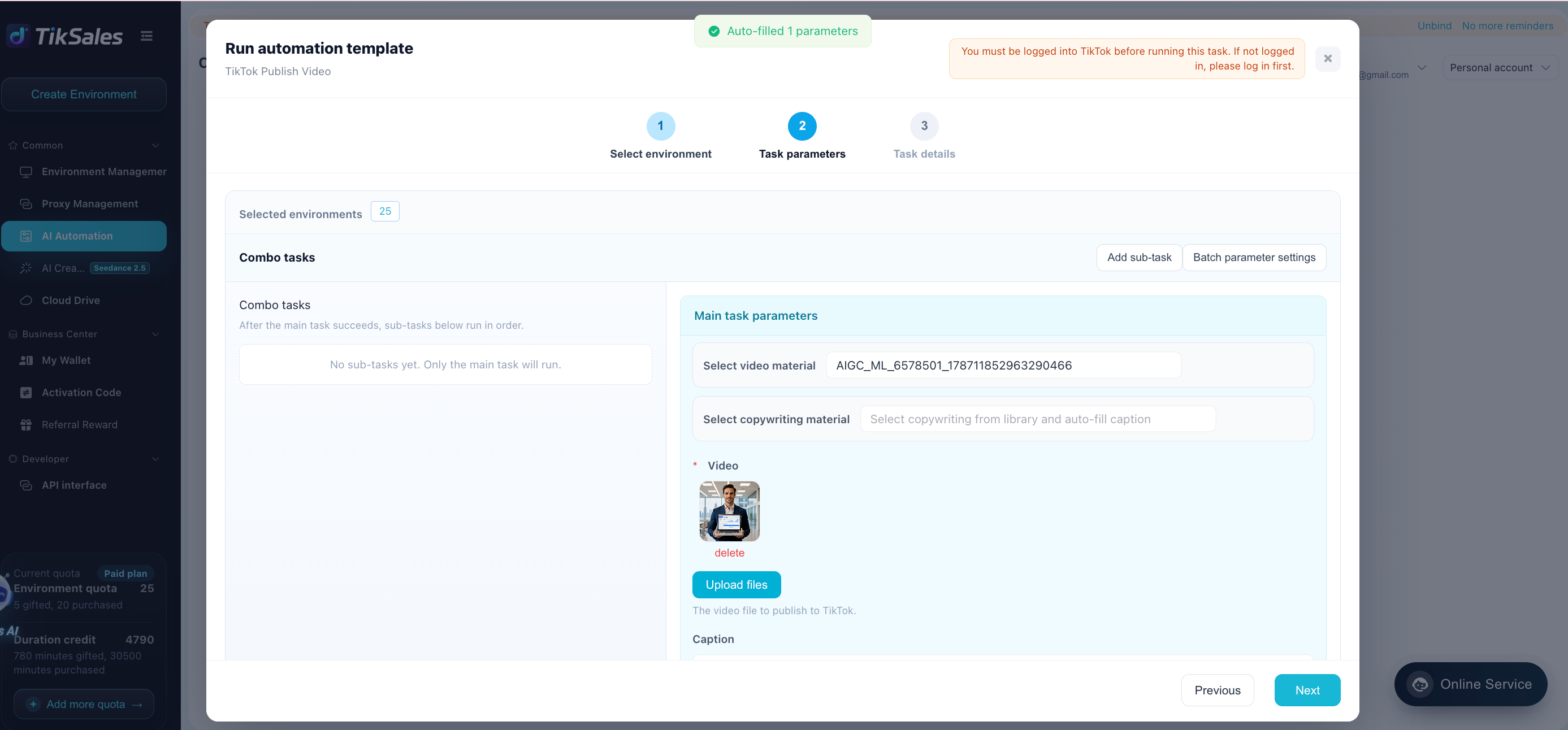
For TikTok teams, the process can begin with the TikSales AI Creative Center to develop content ideas, Hooks, and scripts. Teams can then produce assets using standardized specifications such as 9:16 and 1080 × 1920 px.
After that, TikSales' account management environment and automation capabilities can support multi-account operations and content publishing.
In this workflow, video dimensions are no longer just an isolated production parameter. They become part of a standardized TikTok content production system.
TikTok Video Specs Quick Reference
For everyday use, the key specifications can be summarized as follows:
Keep in mind that TikTok's upload limits and advertising specifications may change based on product updates, region, ad format, placement, or campaign type.
The specifications above are therefore best treated as practical production guidelines. For an actual upload or advertising campaign, always verify the latest requirements displayed by TikTok's platform and Ads Manager.